I Could Have Been a Simple Fool
US — United States, the country where I studied and worked for many years before returning to India.
SUV — Sport Utility Vehicle, the large high-clearance car beloved by men who believe road dominance is a personality.
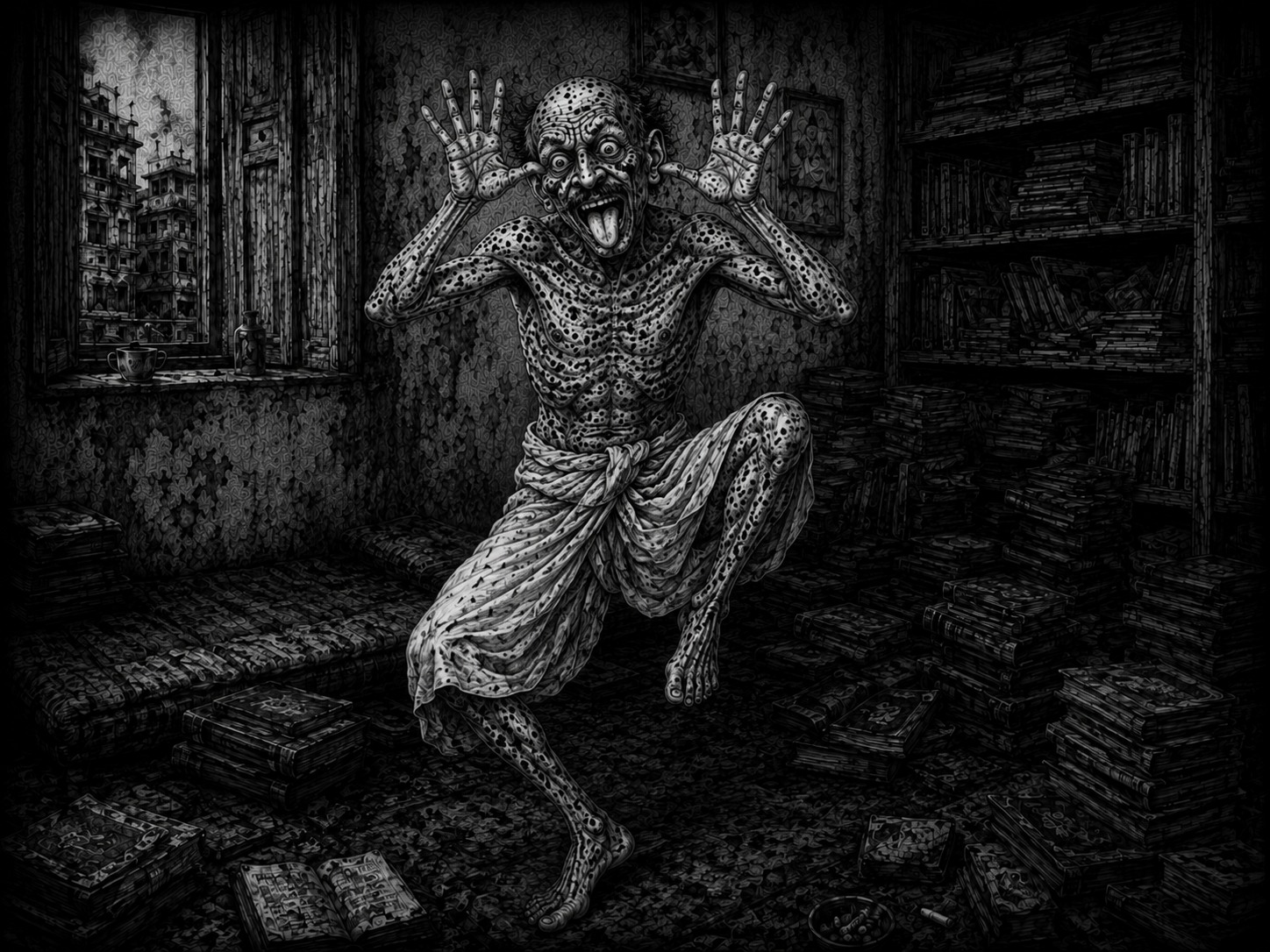
I could have been a simple fool. There was no constitutional barrier against it.
I could have been one of those agreeable men with a plastic smile, a laminated god in the wallet, and the moral flexibility of a wet papad. I could have nodded at power, touched feet, forwarded devotional rubbish on WhatsApp, and said, “What to do, this is India,” while somebody from the balcony of history emptied a bucket on my head and explained that it was rainfall. Sacred rainfall. Development rainfall. Cultural rainfall. Orange-tinted rainfall with a certificate from the appropriate department.
But some manufacturing defect remained.
A little less thinking and I might have been happy.
A little more indoctrination and I might have slept beautifully, like a patriotic buffalo in the warm mud of slogans. But no. Somewhere in childhood the mosquito net of obedience was not tucked in properly. Books got in. Doubt got in. History got in. Science got in with its rude little torch, lifted the bedsheet of civilization, and showed the bedbugs marching underneath like a badly paid municipal procession.
And once you see the bedbugs, praising the mattress becomes difficult.
That is the problem with doubt. It does not arrive like a grand revolution with drums. It enters like damp in a wall. First a patch. Then a smell. Then one day the plaster comes off in your hand and you realize the entire room has been quietly negotiating with fungus for years.
So here I am now.
Fifty-one. Bengali. Single. Lower-middle-class. Mentally uneven. Financially dented. Socially misplaced. Living in the southern rough edges of Calcutta, where the city has not ended exactly, but has begun to lose confidence in itself. The roads narrow. The drains sulk. The wires hang like depressed noodles. The tea shops know more about public policy than most television panels, but charge only ten rupees for the privilege.
My brain, meanwhile, often behaves like a municipal transformer in May. It hums. It sparks. It threatens to explode. It dims the lights in the neighborhood of the soul.
And I am expected to be polite about a country where corruption is not an accident.
It is not a scandal either.
It is a digestive system.
The powerful swallow public life, extract obedience, and excrete slogans onto the poor. Then the poor are asked to stand in line, clap at the smell, and vote for more fiber.
This is where the real trick begins.
The poor are not merely robbed. Robbery would be too honest. They are made to misread the robbery. Their roofs are bulldozed. Their jobs evaporate. Their sons rot in coaching centers, learning to become either engineers, clerks, failures, or all three in a tragic group discount. Their daughters learn caution as a second language. Their cooking gas becomes a financial thriller. Their votes are harvested like cheap potatoes.
Then they are told the real enemy is some invisible demon.
Some historical insult.
Some godly real-estate dispute.
Some divine landlord in the clouds with excellent public relations and a media team.
That is the genius of it.
Not power by intelligence.
Power by distraction.
Make a hungry man argue about heaven while you steal his cylinder. Make a frightened man chant while you auction his future. Make a humiliated man feel superior to another humiliated man, and he will guard the palace gate for free, bring his own tiffin, and thank you for the opportunity.
You think poverty automatically produces wisdom.
It does not.
Sometimes poverty produces generosity. Sometimes it produces patience. Sometimes it produces those remarkable women who can run a whole collapsing household with rice, salt, one onion, and a face like the finance minister of a small island nation.
But sometimes poverty produces cruelty.
Sometimes it produces obedience.
Sometimes it produces superstition with elbows.
Sometimes it produces a man so badly bruised by the boot that he begins to worship footwear.
That is the sentence nobody wants at dinner.
Suffering is not holy. Suffering is a condition. It may enlarge a person, but it may also shrink him into a clerk in hell, stamping the next fellow’s misery because at least today he is the one holding the stamp.
And India, the India I returned to, often feels like a vast clerical office of hell. Forms stamped. Bribes whispered. Gods invoked. Drains overflowing. Politicians smiling like men who have just discovered a fresh public sector undertaking. News anchors barking. Everyone pretending the smell is tradition.
I was away long enough to become foolishly hopeful.
I came back long enough to be corrected.
There is a particular education in returning to India after years in the US. Not the glamorous kind. Not the airport-returned, chocolate-distributing, “there things are so organized” nonsense. That is for people who still think life is a luggage carousel. I mean the slower education. The one where you realize the country is not merely difficult. Difficult can be managed. A difficult country is like a stubborn pressure cooker. It whistles, spits, frightens the cat, but eventually the dal softens.
India is layered.
Bureaucracy over superstition over corruption over fear over class contempt over masculine insecurity over the great national talent for pretending nothing is wrong while everything leaks.
It is not one problem. It is a wedding feast of problems, each dish oily enough to shine under tube light.
And I am inside it too.
That is the important part. I am not floating above the mess like some foreign-returned saint with imported deodorant and moral air-conditioning. I am in the mess. I breathe it. I pay rent in it. I boil rice in it. I sweat in it. I avoid its crowds. I depend on its electricians, plumbers, delivery boys, clerks, drivers, pharmacists, and small shopkeepers, all of us trapped in the same grand leaking machine.
Trust here has been mugged so often it walks with a limp.
Even the day has a suspicious sound. A pressure pump starts. A dog protests. A vegetable seller stretches the word “begun” until it contains all of agricultural history. Somewhere a mixer-grinder screams like democracy being processed for chutney. The phone pings. A bill. A news alert. A fresh outrage. A politician has said something. A godman has said something. A billionaire has bought something. A poor man has lost something. The ceiling fan continues its philosophical rotation, having seen empires, landlords, and unpaid electricity bills.
And in the middle of this, a man like me is supposed to remain balanced.
Balanced.
What a lovely word. Like “fresh” at a fish market in late June.
I am told to control myself by people who worship hysteria in public squares. I am told to be moderate by people who swallow propaganda like temple prasad. I am told to respect faith by men who would watch another man’s home become dust if the correct slogan was shouted first.
No.
Respect is not automatic.
Respect is earned by reality.
And reality, that rude fellow in a torn vest, keeps showing the same picture: people kneeling before invisible power while visible power empties their pockets.
This is why I cannot treat political religion as harmless poetry. Poetry does not usually arrive with bulldozers, television studios, police permission, and a financing structure. Myth by itself may be a story. Myth in the hands of power becomes a weaponized bedtime tale. It tells adults to sleep while thieves work.
And I cannot sleep.
That is my defect.
That is my tiny, useless rebellion.
I remain awake in a country professionally committed to stupor.
Not nobly awake. Please do not decorate me. I am not some marble bust of dissent. I am a shabby, anxious, overeducated, underpaid man sitting with bills, bad sleep, an aging body, a brain with faulty wiring, and a mouth that sometimes behaves like an unlicensed fireworks shop.
Sometimes the obscene words come because the facts are obscene.
You cannot describe a sewer collapse in the language of scented candles.
This does not mean filth is clever by itself. Most filth is boring. A bad swear word is like cheap pickle: loud, red, and mostly oil. But sometimes filth becomes an emergency language. A pressure valve. The short, ugly noise a mind makes after watching hypocrisy wear sandalwood paste and ask for respect.
My bipolarity is not the joke.
The joke is that a society this mad still thinks my diagnosis is the strange part.
Look around. We have made a national hobby of public delusion. We have men shouting about ancient glory while unable to keep a drain clean. We have citizens who can detect an insult to mythology from four thousand years away but cannot detect theft occurring this afternoon. We have people who can debate civilization on television while stepping over the man sleeping under the flyover like an inconvenient comma.
And then someone says, “Be positive.”
Positive about what exactly?
About the heat? The rent? The job market? The price of cooking gas? The great achievement of being told to feel proud while your pocket develops an echo?
Still, I do not hate the poor. That is the part the smug will deliberately misunderstand, because misunderstanding is cheaper than conscience. I am angry because the poor suffer and are then recruited into defending the machine that makes them suffer. I am angry because the same man whose roof may be crushed tomorrow is today laughing at someone else’s roof being crushed. I am angry because pain does not automatically produce solidarity. Sometimes pain learns the uniform of power and begins marching.
This is the great Indian tragedy in miniature.
The victim wants to be promoted to assistant oppressor.
Not free. Promoted.
There is a difference.
Freedom is hard. It requires thought. It requires doubt. It requires saying, “Maybe the fellow who is flattering me is also robbing me.” Promotion is easier. You get a slogan, a badge, a little borrowed cruelty, and the warm feeling that somebody below you is having a worse afternoon.
That is how the palace survives.
Not because everyone inside it is clever.
Because enough people outside it are persuaded to defend the gate.
And I know, I know, I sound bitter.
Fine.
I am bitter.
Bitterness is what honesty tastes like after being kept too long in a hot room without refrigeration.
But beneath the bitterness there is something softer and more foolish. Some wounded civic animal still believes people were not born merely to be cheated, frightened, divided, and sold religious fog by men with bank accounts. I know this belief may be childish. I know the obedient fellow may have the better life. He will eat, nod, marry, reproduce, forward devotional garbage, and die with a blood pressure tablet under his tongue and certainty in his pocket.
I got doubt instead.
Doubt and books and loneliness and a faulty nervous system and a small rented life on the edges of Calcutta, where the evening sometimes arrives like a tired clerk, removes its shoes, and sits beside you without speaking.
So be it.
Let the obedient call me obscene. Let the respectable call me bitter. Let the patriots say I insult the motherland. I know the motherland. She is not a goddess. She is an exhausted woman standing in a ration line while men on posters use her name to buy SUVs.
And I, her shabby, bad-tempered, overeducated, underpaid, underloved son, am standing somewhere behind her, muttering under my breath, not because I enjoy the stink, but because I refuse to call it incense.